How to Ask Someone to Repeat or Clarify in English
Choose the repair phrase that matches the problem: ask for repetition, slower speech, a spelling, an explanation, or confirmation.
By the Ledoly team
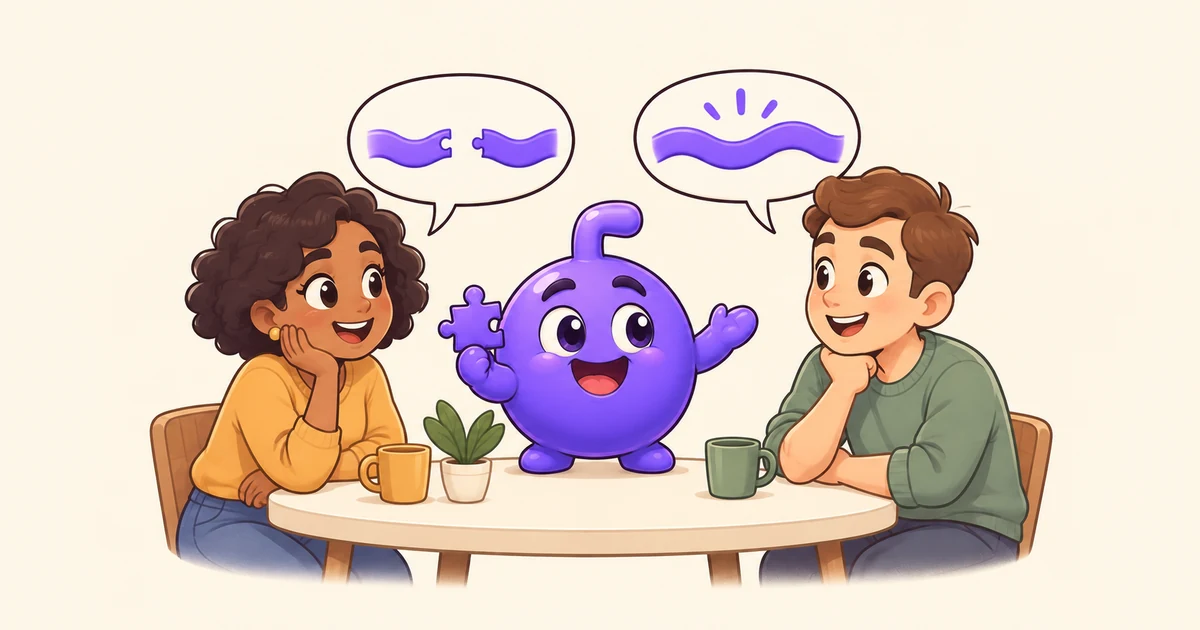
When you do not understand, ask for the specific help you need. Say “Could you say that again, please?” when you missed the message, “Could you say that more slowly?” when speed is the problem, “What does ___ mean?” when a word is unfamiliar, or “Do you mean ___?” when you want to confirm your interpretation. A precise request is easier to answer than a general “I don’t understand.”
Emma: Let’s meet by the west entrance at fifteen after nine.
Sam: Sorry, did you say 9:15?
Emma: Yes, 9:15 by the west entrance.
Sam does not ask Emma to repeat everything. He checks the one detail that matters.
Match the phrase to the problem
| What went wrong? | Useful phrase |
|---|---|
| You missed the whole message | Could you say that again, please? |
| You missed the last part | Sorry, I didn’t catch the last part. |
| The person spoke too quickly | Could you say that a little more slowly? |
| One word was unclear | Which word did you say after “schedule”? |
| A name or code is unclear | Could you spell that for me? |
| You heard the words but not the meaning | What do you mean by “move it up”? |
| You have a possible interpretation | Do you mean we should meet earlier? |
| You need to verify a detail | Just to confirm, the address is 18 King Street, right? |
You can begin with sorry or excuse me to make the interruption gentler. Cambridge Dictionary notes that sorry can be used when politely asking someone to repeat something. Adding please can also make a request more polite.
When you did not hear
Use a repetition request when noise, volume, or a brief loss of attention caused the problem:
- Sorry, could you say that again?
- Could you repeat the last sentence, please?
- I didn’t catch the name. Could you say it again?
- Sorry, the connection cut out. What did you say after “Thursday”?
“Sorry?” can work as a short request, but it depends heavily on tone and context. A complete sentence is safer when you do not know the person well or when the detail is important.
When the speed is the problem
Asking someone to repeat at the same speed may not help. Ask for a slower version:
- Could you say that a little more slowly?
- Could you repeat the address slowly, please?
- Could we go through those steps one at a time?
Focus the request when possible. “Could you repeat the address slowly?” gives the speaker a clear task. For practice outside the conversation, Ledoly’s guide to understanding fast American English shows how to identify whether you missed sounds, words, grammar, or context.
When one word, name, or number is unclear
Ask for the smallest missing unit:
- Could you spell your last name?
- Was that thirteen or thirty?
- Did you say room 406?
- Which entrance did you say?
- Could you repeat the confirmation code?
For names, addresses, dates, and numbers, repeat the information back. This gives the other person a chance to correct it immediately.
Ben: The last name is Carter: C-A-R-T-E-R.
Mia: C-A-R-T-E-R. Is that right?
Ben: Yes, that’s right.
When you heard the words but not the meaning
Repetition is not enough if the vocabulary or idea is unfamiliar. Ask for an explanation:
- What does “tentative” mean here?
- What do you mean by “push the meeting back”?
- Could you explain that in another way?
- Could you give me an example?
“I didn’t quite follow” is another useful option. Here, follow means understand, not walk behind someone.
When you want to confirm your understanding
If you think you understand, say your interpretation and invite a correction:
- Do you mean the meeting starts earlier?
- So we need to send the final version today. Is that right?
- Just to confirm, you’re arriving on Friday, not Thursday?
- Let me make sure I have this right: Sam will call the client, and I’ll send the notes.
This is often faster than asking for a full repetition. It also shows which part you understood.
A simple repair pattern
Use this three-part pattern when the situation is important:
- Signal the problem: “Sorry, I missed the last part.”
- Ask for one action: “Could you repeat the date?”
- Confirm the answer: “Tuesday, October 13. Is that right?”
Emma: Please send the form to Ben before noon on Tuesday.
Mia: Sorry, I didn’t catch the deadline. Could you repeat it?
Emma: Before noon on Tuesday.
Mia: Before noon Tuesday. Got it.
In friendly conversation, repair can be brief. Ledoly’s small-talk guide gives you more examples of short turns and follow-up questions. For calls and connection problems, browse the Phone, Email & Tech listening section.
What to do after a second failed attempt
If you still do not understand, change the method instead of repeating the same request:
- Ask for only the missing word or number.
- Ask the speaker to spell a name.
- Repeat what you understood and leave a blank: “I heard ‘Meet Ben at ___ entrance.’”
- Ask for the detail in writing: “Could you send me the address in a message?”
- Move to a quieter place or improve the connection if possible.
You do not need to apologize repeatedly. One polite signal, one clear request, and one confirmation are enough.
Practice: choose the best repair phrase
Write one useful response for each situation.
- A train passes while Sam says the meeting place. You hear nothing.
- Emma gives a five-step process very quickly.
- A caller says the last name “Reed,” but you are unsure how to write it.
- Ben says, “Let’s push the meeting back.” You hear every word but do not know whether he means earlier or later.
- You think Mia said the appointment is at 2:30, but the time is important.
- The call breaks up only when the person says the street number.
Answer key
- “Sorry, could you say that again?” You missed the whole message.
- “Could you go through those steps a little more slowly?” The speed, not the volume, is the problem.
- “Could you spell your last name for me?” Ask for the exact missing information.
- “What do you mean by ‘push the meeting back’?” Ask for meaning, not repetition.
- “Just to confirm, did you say 2:30?” State your interpretation and invite correction.
- “Sorry, the connection cut out. Could you repeat the street number?” Ask only for the lost detail.
Other wording can work. The important choice is the kind of help you request.
Frequently asked questions
Is saying “What?” rude?
It can sound abrupt, especially with a stranger or in a formal setting. Tone and relationship matter. “Sorry?” or “Could you say that again, please?” is usually a safer choice.
What is the difference between repeat and clarify?
A repetition gives you the same words again. Clarification explains the words or makes the meaning more specific. Ask for clarification when you heard the sentence but did not understand the idea.
How do I ask about a name I did not understand?
Say “Could you repeat your name?” If the sound is still unclear, ask “Could you spell that for me?” Then repeat the spelling back.
What if I still do not understand after two tries?
Summarize what you understood, identify the missing detail, and change the method. Ask for a spelling, an example, or a written message instead of requesting the whole sentence again.
Sources and further practice
- Cambridge Dictionary: Please and thank you — using please to make requests more polite.
- Cambridge Dictionary: sorry — polite uses when asking someone to repeat.
- Cambridge Essential American Dictionary: follow — the meaning “understand.”
- British Council LearnEnglish: Checking understanding — repetition, slower speech, and confirmation phrases.