Make, Do, Take, and Have: Common Collocations
Learn make, do, take, and have as complete word partnerships, from make a decision to have a conversation.
By the Ledoly team
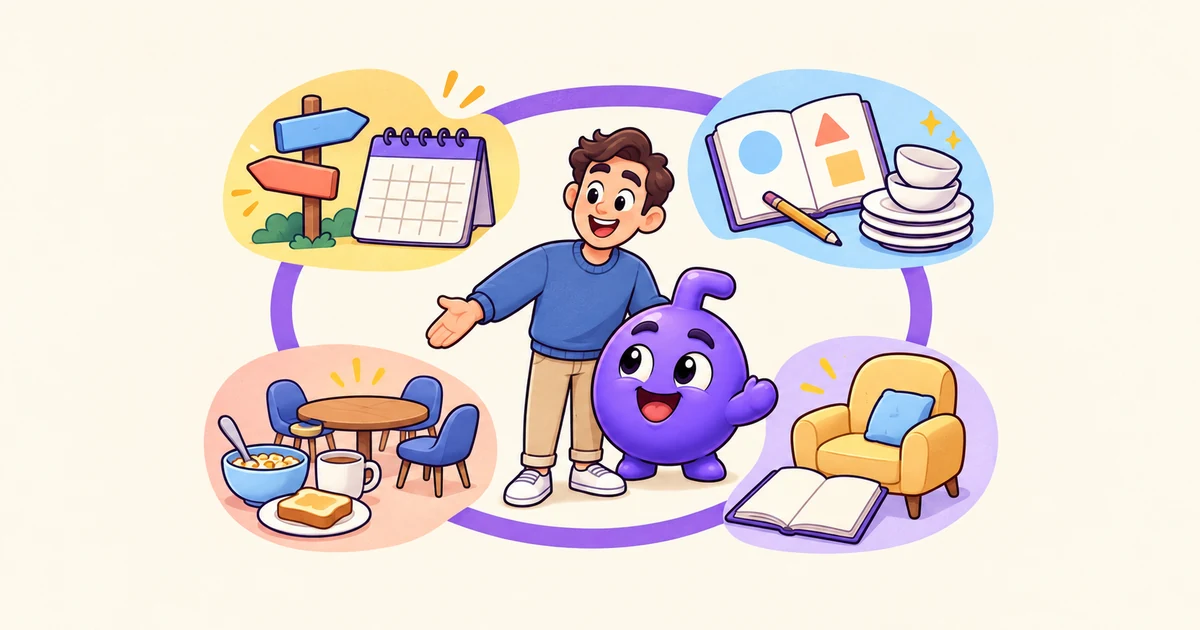
Use make for combinations such as make a decision, do for do homework, take for take a break, and have for have a conversation. These are collocations: words that regularly occur together. Learn each verb and noun as one reusable chunk instead of translating the words separately.
A different verb may be grammatically possible in another sentence, but the familiar collocation is often the combination an English speaker expects for that meaning. For example, a person does work but makes progress.
What is a collocation?
A collocation is a typical word partnership. Collocations can combine an adjective and noun, a verb and noun, an adverb and adjective, or other word classes. This guide focuses on four high-frequency verbs followed by nouns.
Collocations are not exactly the same as idioms or phrasal verbs:
- Collocation: make a decision. The words keep their usual meanings, but this is the expected partnership.
- Idiom: break the ice. The full meaning is not simply the literal meaning of each word.
- Phrasal verb: follow up. A verb combines with a particle or preposition.
For the third category, see Ledoly’s guide to American workplace phrasal verbs.
The main pattern: result, task, action, experience
These four ideas are useful starting points:
- make often points to a result, plan, or something created.
- do often points to work, a task, or an activity.
- take appears in many action and responsibility chunks.
- have often introduces an experience, meal, event, or situation.
These are tendencies, not rules that can predict every phrase. Treat the complete collocation as the unit to remember.
Common collocations with make
| Collocation | Example | Register |
|---|---|---|
| make a decision | “We need to make a decision by Friday.” | Neutral; workplace-safe |
| make a mistake | “Ben made a mistake in the total.” | Neutral; workplace-safe |
| make progress | “Emma is making progress on the report.” | Neutral; workplace-safe |
| make an appointment | “Mia made an appointment for Monday.” | Neutral |
| make a phone call | “Sam stepped outside to make a phone call.” | Neutral |
Make often suggests that an action produces a result: a decision, plan, mistake, or change. However, meaning alone cannot predict every combination. English uses make a phone call, even though a call is also an activity.
Common collocations with do
| Collocation | Example | Register |
|---|---|---|
| do homework | “Ben does his homework after dinner.” | Neutral |
| do the dishes | “I’ll cook if you do the dishes.” | Neutral; everyday |
| do research | “Emma did research before the presentation.” | Neutral; academic and workplace-safe |
| do business | “The two companies do business together.” | Neutral; workplace-safe |
| do someone a favor | “Could you do me a favor and check this?” | Neutral; friendly request |
Do often goes with work and activities. Notice that homework and research do not take a in these meanings: say “do homework” and “do research,” not “do a homework” or “do a research.”
Common collocations with take
| Collocation | Example | Register |
|---|---|---|
| take a break | “Let’s take a short break.” | Neutral; workplace-safe |
| take notes | “Mia took notes during the call.” | Neutral; workplace-safe |
| take a photo | “Sam took a photo of the view.” | Neutral |
| take a chance | “Ben took a chance and asked.” | Neutral |
| take responsibility | “Emma took responsibility for the final check.” | Neutral; workplace-safe |
The verb take has many meanings, so its collocations are especially useful to learn as complete chunks. Compare take notes, take a break, and take responsibility for something.
Common collocations with have
| Collocation | Example | Register |
|---|---|---|
| have breakfast | “Mia had breakfast before she caught the train.” | Neutral; everyday |
| have a meeting | “We have a meeting at 10:00.” | Neutral; workplace-safe |
| have a conversation | “Ben had a conversation with his manager.” | Neutral; workplace-safe |
| have a problem | “I’m having a problem with the printer.” | Neutral; workplace-safe |
| have an idea | “Emma has an idea for the event.” | Neutral; workplace-safe |
Have does not always mean possession. In have breakfast, have a meeting, and have a conversation, the noun carries most of the action or event meaning.
Useful contrasts to remember
| Use this | Not this for the same meaning | Example |
|---|---|---|
| make a decision | do a decision | “Let’s make a decision today.” |
| do homework | make homework | “Sam is doing his homework.” |
| have a meeting | do a meeting | “We’re having a meeting this afternoon.” |
Make notes exists, but it can focus more broadly on creating written notes. In common American classroom and meeting instructions, take notes is the safer default for recording key information.
A single situation can use several collocations together:
“We had a meeting, took notes, did more research, and made a decision.”
For phone situations, Ledoly’s English phone-call phrases show how a chunk such as take a message fits into a complete conversation.
How to learn collocations as chunks
- Record the whole partnership. Write make a decision, not only decision.
- Add one original sentence. Connect the chunk to your life: “I need to make an appointment this week.”
- Keep the small grammar words. Learn take a break and have a conversation, including the article.
- Notice nearby chunks. In a real conversation, collect phrases that share the same situation, such as have a meeting, take notes, and make a decision.
- Review by noun. If you want to express progress, recall the partner make. If you want to express homework, recall do.
Practice: choose make, do, take, or have
Choose the correct verb and change its form when the sentence requires past or present tense.
- We need to ___ a decision by Friday.
- Could you ___ me a favor?
- Let’s ___ a break after this section.
- Mia usually ___ breakfast at 7:00.
- Ben ___ a mistake in yesterday’s total.
- Emma ___ notes during yesterday’s meeting.
- Sam ___ research before his presentation last week.
- Mia needs to ___ an appointment.
- The two companies ___ business together.
- We ___ a problem with the order.
- I need to ___ a phone call.
- Who will ___ responsibility for the final check?
Answer key
- make — make a decision
- do — do someone a favor
- take — take a break
- has — have breakfast
- made — make a mistake
- took — take notes
- did — do research
- make — make an appointment
- do — do business
- have — have a problem
- make — make a phone call
- take — take responsibility means agreeing to be in charge of something. Have responsibility is also correct here; it simply means being in charge.
Now choose four answers—one with each verb—and say a new sentence about your own day. Keep the complete collocation together.
Frequently asked questions
What is an English collocation?
A collocation is a typical combination of words, such as make a decision or take a break. The individual words keep recognizable meanings, but speakers regularly choose them together.
What is the difference between make and do?
Make often points to a result or something created, while do often points to work, a task, or an activity. This is only a starting pattern, so learn complete chunks such as make progress and do homework.
Is a collocation the same as an idiom?
No. A collocation is a typical word partnership whose meaning is usually fairly transparent, such as have a meeting. An idiom has a meaning that cannot always be predicted from its individual words.
How can I remember make, do, take, and have collocations?
Store each verb and noun as one chunk, add an original sentence, and review the chunks by situation. For a meeting, for example, practice have a meeting, take notes, and make a decision together.
Sources
- Oxford Learner’s Dictionaries: Using the Oxford Collocations Dictionary — defines collocation as the way words combine to produce typical, natural-sounding language and explains how dictionary evidence identifies common combinations.
- British Council LearnEnglish: Delexical Verbs — documents common noun combinations with have, take, make, and do.
- Oxford Advanced Learner’s Dictionary: Make — contrasts do for activities and tasks with make for creating or preparing, and records common make combinations.